Where to Buy Ball Bearings: A Practical Buyer's Guide
Where to Buy Ball Bearings: A Practical Buyer's Guide
If you have ever typed "where buy ball bearings" into a search bar at 11 p.m. because a machine is down and a $4 part is holding up a $40,000 production line, you already know the real question is not where — it is where to buy a bearing that will not fail in three weeks. The market is full of genuine parts, gray-market copies, and outright fakes, and they all look identical in a photo. This guide walks through the actual channels, how to judge them, and how to verify a bearing before money changes hands.
↑ Back to topUnderstand What You Are Buying Before You Shop
A ball bearing is a precision assembly, not a commodity hardware item. Two bearings with the same bore, outer diameter, and width can differ by a factor of five in price and by an order of magnitude in service life. Before comparing sellers, be clear about what specification you actually need.
↑ Back to topBall Bearings vs. Roller Bearings
Ball bearings carry load on spherical rolling elements and suit high-speed, moderate-load applications — electric motors, fans, pumps, spindles. Roller bearings use cylindrical, tapered, or spherical rollers and handle heavier radial loads at lower speeds. If a supplier's catalog mixes the two without distinction, that is a signal about how carefully they curate inventory.
↑ Back to topCommon Bearing Types and Their Applications
↑ Back to topMiniature Bearings (Under 10 mm Bore)
Found in 3D printers, RC vehicles, dental handpieces, and small BLDC motors. Tolerances here are tight relative to size, and counterfeit miniature bearings are extremely common on general marketplaces.
↑ Back to topDeep Groove Ball Bearings
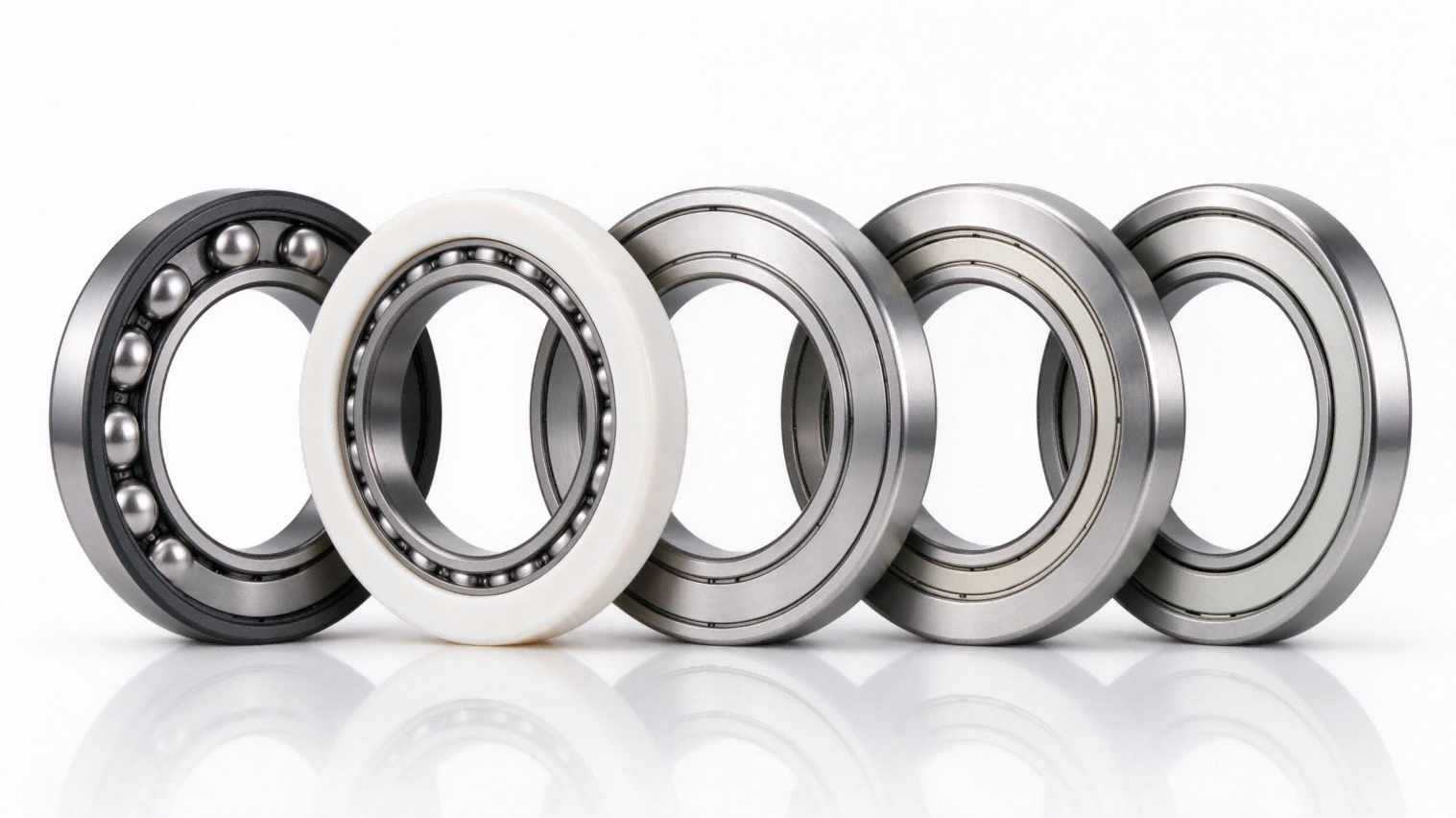
The workhorse: 6000, 6200, and 6300 series. Single-row, available open, shielded (ZZ), or sealed (2RS). Most "where to buy ball bearings" searches end here, and most industrial applications are served by this family.
↑ Back to topAngular Contact and Thrust Bearings
Angular contact bearings take combined radial and axial loads and are usually mounted in pairs. Thrust bearings take axial load only. These are application-critical parts — buy them from a source that can confirm preload and pairing, not from a bin listing.
↑ Back to topWhere to Buy Ball Bearings: The Main Channels
There are four realistic channels. Each has a distinct risk profile.
↑ Back to topAuthorized Distributors
Distributors carrying a manufacturer's authorization — SKF, NSK, NTN, Schaeffler (FAG/INA), Timken, NSK — are the safest route for production-critical bearings. You pay list price or close to it, but you get traceable lot numbers, genuine packaging, and a warranty that a manufacturer will actually honor.
Why Authorization Matters for Bearing Quality
An authorized distributor buys from the manufacturer, stores parts within shelf-life limits, and can produce a certificate of origin. An unauthorized reseller may be selling genuine surplus, may be selling re-labeled parts, or may be selling a bearing that sat in a humid warehouse for six years. The bearing looks the same. The failure mode does not.
↑ Back to topIndustrial Supply Houses and Local Bearing Shops
Local bearing shops are underrated. They stock the odd sizes, they will match a bearing by dimension when the number is worn off, and they can have a replacement in your hand in an hour. For maintenance and repair work, the premium over online pricing is usually worth it. For OEM production volumes, it is not.
↑ Back to topOnline Marketplaces
Large marketplaces are excellent for low-criticality bearings: hobby projects, prototypes, non-safety fixtures. They are a poor choice for anything where downtime is expensive, because seller quality varies enormously and returns are easy but failures are not.
How to Vet an Online Bearing Seller
Look for a business account rather than an individual, a stated manufacturer relationship, dimensional drawings rather than only lifestyle photos, and a return policy that covers "not as described." Ask one technical question — clearance class, cage material, or limiting speed — and see whether the answer is specific. A seller who cannot answer is a reseller who never touched the product.
↑ Back to topBuying Bearings Direct from Manufacturers
For volume buyers, direct purchase removes a margin layer and gives you engineering support. Most major manufacturers will route small inquiries to a distributor, but they will engage directly on annual contracts, custom designs, or where a specific application needs joint analysis.
When Direct Sourcing Makes Sense
Direct sourcing pays off when annual consumption is predictable, when the bearing is application-critical, and when you need documentation for an audit or a regulated industry. It rarely pays off for one-off replacement orders.
↑ Back to topSurplus and Refurbished Bearings
Surplus industrial stock — plant closures, canceled projects, obsolete inventory — can be a genuine bargain for non-critical use. Two rules: never buy surplus for safety-critical applications, and always inspect for rust, seal damage, and free-rotation smoothness before installing. A bearing that has been stored badly is already degraded even if it has never turned.
↑ Back to topHow to Verify a Bearing Before You Pay
Verification is the step most buyers skip, and it is the step that separates a good purchase from an expensive lesson.
Read the Bearing Number Correctly
A designation like 6205-2RS1/C3 decomposes into: 62 series, 25 mm bore, double rubber seal, C3 radial internal clearance. Getting the suffix wrong is the single most common buying error — a C3 clearance bearing in a precision spindle application will run noisy and fail early, and it is not a defect.
Suffixes, Clearances, and Shields
ZZ / 2Z — metal shield, low drag, not water-resistant
2RS / 2RS1 — contact rubber seal, better contamination protection, lower speed limit
C2 / CN / C3 / C4 — radial internal clearance, from tighter to looser
P5 / P6 / P4 — precision grade, tighter running accuracy
TN9 / TVH — cage material, polyamide versus brass
Physical Checks That Take Two Minutes
Spin the bearing: it should turn smoothly with a faint, even sound and no gritty sensation. Check the seal lip for uniformity. Look at the laser marking — counterfeit markings are often shallow, misaligned, or applied over a coating. Weigh it if you can; fakes frequently use lower-grade steel and come in light.
↑ Back to topWhat a Bearing Should Cost
As a rough sanity check for common deep groove sizes, expect genuine branded 6200-series bearings in the range of a few dollars each in small quantities, with volume pricing dropping sharply above a few hundred pieces. Prices far below that range usually indicate either surplus, unbranded product, or counterfeit. Prices far above it usually indicate a distributor with no competition on that line item — worth a second quote.
↑ Back to topCommon Buying Mistakes
- Buying on dimension alone and ignoring clearance and precision grade
- Mixing brands within a matched pair or a preloaded set
- Choosing sealed bearings for high-speed applications where they will overheat
- Ordering from a marketplace seller for a line that stops production when it fails
- Assuming a higher price guarantees authenticity without checking traceability
FAQ
Where is the best place to buy ball bearings?
For production-critical equipment, an authorized distributor of a major brand is the best place — you get traceability and a real warranty. For maintenance and repair, a local bearing shop is often fastest. For hobby and prototype work, online marketplaces are fine if you vet the seller.
Can I buy ball bearings directly from the manufacturer?
Usually only at volume. Most manufacturers route small orders to their distributor network, but they will engage directly for annual contracts, custom designs, or technically demanding applications.
How do I know if a bearing is genuine?
Check the laser marking quality, the packaging and lot labeling, and the weight. Ask for a certificate of origin. The most reliable method is buying from an authorized distributor — counterfeits are nearly indistinguishable visually.
Are cheap bearings on marketplaces worth it?
For non-critical, low-speed, low-load applications, yes. For anything where failure causes downtime, safety risk, or damage to surrounding parts, no. The savings are small relative to the cost of a failure.
What do the letters and numbers on a bearing mean?
The number gives series and bore size (6205 = 62 series, 25 mm bore). Suffixes define seals, shields, clearance, precision grade, and cage material. Always match the full designation, not just the dimensions.
How many bearings should I keep in stock?
Enough to cover lead time on your most failure-prone positions. A common approach is two spares for any bearing on a critical machine, and one spare for the rest. Bearings deteriorate in storage, so rotate stock and keep them sealed and dry.
Do bearing prices vary that much between sellers?
Yes — often by 300% or more for the identical designation. Always get two or three quotes for anything above trivial value, and treat unusually low prices as a question to investigate rather than a bargain to grab.
what to consider when sourcing bearings from china
Related Article